127 Top Business Jargon Examples [And How to Fix Them] for Better Business Writing

![127 Top Business Jargon Examples [And How to Fix Them] for Better Business Writing](https://www.instructionalsolutions.com/hubfs/Top%20Business%20Jargon%20%26%20Gobbledygook%20Examples.png)
Table of Contents
Skilled business writing rejects business jargon. Yet, industry-specific phrases and buzzwords are very commonly used. Even the best writers and business leaders can fall into the jargon trap if they’re not careful.
Fortunately, by using the right perspective, you can revise business buzzwords out of your text or avoid it in the first place.
This article will highlight the perspective that is needed to easily identify confusing jargon. To start you off on your jargon hunt, we’ve also prepared our list of the top 127 jargon and gobbledygook examples in business writing.
Why Does Business Jargon Exist?
Sadly, the primary reason business writers use too much jargon is everyone else is using it. We learn to write by modeling others. Business writing is notorious for corporate lingo. There is even a book that addresses this problem, Why Business People Sound like Idiots.
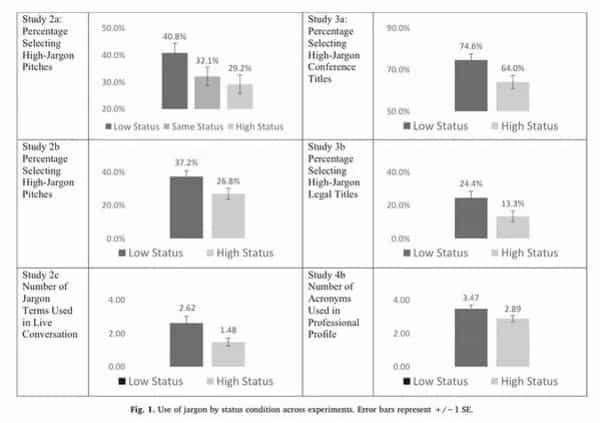
Meaningless jargon has become so commonplace that the writer does not perceive the term as jargon. Instead, the writer incorrectly sees jargon as an insider-term or in-the-know business dialect. However, this writing ignores the most crucial factor in business writing: the audience.
Jason Fried, the founder of Basecamp and author of Rework, stated, “Jargon is insecurity.” Instead of using strong, clear, words that accurately reflect concepts, we lapse into vague corporate-speak by parroting beaten-to-death jargon.
To help combat corporate jargon in professional writing we created the Jargon Grader. It’s a simple app that helps you identify and eliminate jargon in your writing. Just paste your text into the application and review the flagged words. Try the Jargon Grader for free [click here].
The Essential Perspective
Jargon is defined as language that is not well understood outside of a specified group. Therefore, useful language for one group could be total jargon to another group.
The only way to know if a term is jargon or not is to put yourself in the shoes of your audience. How well does your reader understand the document topic? An executive in your company is likely familiar with company-wide acronyms. Conversely, a client might be confused by the same acronym.
Jargon or gobbledygook phrases must be revised or placed in a context that makes the idea accessible to the reader. This may mean fully writing out acronyms, explaining terminology, or modifying the content to better orient the reader.
Overused colloquial phrases, such as “at the end of day,” weaken your message. A phrase like this is so beaten to death that it no longer has any resonant meaning.
"Plain language removes barriers between you and your readers," says Hoa Loranger at the Nielsen Norman Group. "No one has ever complained that a text was too easy to understand."
The “but it sounds nice” Trap
Business writing has a clear purpose. It is generally meant to inform or persuade.
It’s tempting to use impressive-sounding language to persuade the reader of your personal competence in the subject area. It seems like an easy way to demonstrate your knowledge. Plus, you’re including the latest industry terms, which shows what your company knows is on trend. Doesn’t it sound nice?
However, this tactic will often leave the reader confused or ill-informed. Jargon is easy to skim past. Buzz terms are so overused that they have lost real meaning.
A good writer proves their subject area expertise by being able to communicate it to any audience. Audience comprehension of a complex topic is the best proof of your knowledge.

Eliminate jargon in your business writing with our free Jargon Grader tool.
Try it nowThe Top 127 Jargon and Gobbledygook Examples
-
110% - Isn’t that just bad math? Exaggeration brings questions to your other numbers.
-
Actionable
-
Agile - Are you using the Agile methodology? If not, you’re using a buzzword.
-
A-ha moment
-
All-hands meeting
-
ASAP - But, when? Specific dates and times create action.
-
At this point in time - Simplicity is bliss. Try: At this point or Now
-
Authentic
-
Back of the envelope - Try: initial estimate or rough calculation
-
Balls in the air
-
Bandwidth - Try: capacity or time
-
Bang for the buck - Easy to promise, but what does it really mean?
-
Banner year
-
Beat the bushes
-
Beef up - Try: reinforce or intensify
-
Best in class
-
Best practices
-
Big bang for the buck
-
Bleeding edge
-
Boil the ocean
-
Boondoggle - Using a cute word for a mistake won’t make the explanation easier.
-
Boots on the ground
-
Brain dump
-
Bring to the table
-
Buck the trend
-
Build capacity
-
Buzzworthy
-
Cast a wider net
-
Change agent
-
Circle back - Try: revisit or discuss later
-
Core competency
-
Corporate values
-
Cradle to grave
-
Crowdsource
-
Crushing it - It may be Gary Vaynerchuk’s favorite phrase, but what does it really mean?
-
Culture fit
-
Deep dive
-
Dialogue
-
Do more with less
-
Drill down - Try: analyze or scrutinize
-
Drink the kool-aid
-
Due diligence
-
Empower
-
End of week
-
Fire fighting
-
First and foremost - You can drop the ‘and foremost’ for a stronger, simpler sentence.
-
Food chain
-
Forward planning - Can one plan backward?
-
Frictionless
-
Game changer
-
Growth hacking
-
Guesstimate
-
Hand holding
-
Hard stop
-
Headwinds - Try: challenges or constraints
-
Hyperlocal
-
Ideation
-
Impact - Everyone loves impact, but it can easily be a fluff word. Give it real meaning.
-
In the black
-
In the loop
-
In today’s world - What other world are we in?
-
Irregardless - Most believe this word is not a word.
-
It's a paradigm shift
-
It is what it is - Why not add “...and I don’t care.”
-
Kick the tires - Try: test or trial
-
Knee deep
-
Land and expand
-
Let's be honest - What is the other option?
-
Leverage
-
Lipstick on a pig
-
Lots of moving parts
-
Low hanging fruit
-
Magic bullet
-
Make it pop
-
Mission-critical
-
Move the needle - This phrase calls for statistics. Do you have them?
-
New normal
-
On the runway
-
Open the kimono
-
Organic growth
-
Special projects
-
Peel the onion
-
Perfect storm
-
Personal brand
-
Pre-think - Does ‘pre’ add any value here?
-
Productize - Does your audience see this verb as a word?
-
Pull the trigger - Try: initiate or kick-off
-
Raise the bar
-
Reinvent the wheel
-
Reach out
-
Resource intensive
-
Results-oriented - This should be a given.
-
Revolutionize - A rare occurrence stated commonly.
-
Robust
-
Run it up the flagpole
-
Scalability
-
Secret sauce
-
Shovel ready - Try: prepared or simple ready
-
Silver bullet
-
Solutioneering - Be careful of words that didn’t exist last year.
-
Stopgap
-
Strategic partnership - Which partnerships are not strategic?
-
Straw man
-
Summit
-
Survival strategy
-
Sweetheart deal
-
Swimlane
-
Synergy - Perhaps the most infamous jargon term.
-
Table the conversation
-
Tailwinds
-
Take offline
-
Take it to the next level
-
Tee up
-
Test the water - Try: trial or investigate
-
Thought leader - Today, everyone is a thought leader. Use the term thoughtfully.
-
Tiger team
-
Top of mind
-
Touch base - Try: contact or chat
-
Transparent
-
Triage
-
Trim the fat
-
Upstream
-
Value add - value implicitly adds value. If there is no add, there is no value.
-
Vertical
-
Viral
-
War room
-
Where the rubber meets the road - Try: implementation area
Note, this list of jargon examples does not include individual company jargon, which must be tracked and translated into everyday business-speak. Only you can navigate and identify your organization’s unique brand of business jargon phrases.